

At the time of writing, the final tonnes of WA’s largest harvest are being delivered into storage. GIWA’s December report estimated 26.5mt (total crop) and, with over 24mt in the CBH network, that number should be exceeded. An old fashioned bin buster.
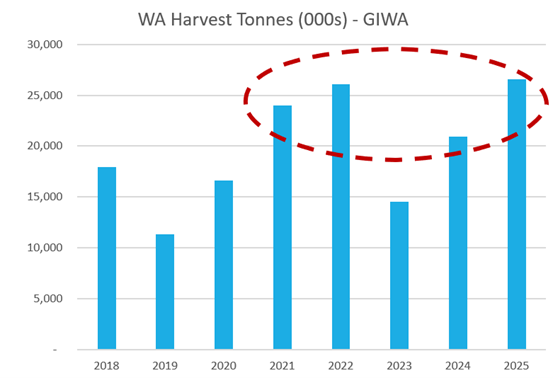
However, it has barely made the news – bin busting is just not unusual these days. The last five years have seen the four largest harvests – ever – with three of those years breaching previous highs. Breaking records has become as common as a nineties steroid-fuelled Olympics.
In the not-so-distant past, big harvests needed an early start, a soft finish and a wet middle, and those three planets aligning is not a common event. But in recent times, the seasonal trifecta has dropped in importance. Case in point: the 2024 season only had a wet middle after a particularly late, dry and hot ‘start’ and the finish was also dry – but it still racked up the third biggest harvest on record.
So, what's going on? Wasn’t the drying climate supposed to result in half the eastern wheatbelt turning their farms over to carbon sequestration by now? Let's examine the potential reasons:
Fewer Sheep
One of the most commonly cited reasons is the reduction of the sheep flock, their paddock presence being mutually exclusive to a tillering wheat crop after all. It’s a question which one came first, good money in cropping knocking sheep out of the rotation, or younger growers getting jack of sheep work when they could fill pasture paddocks with canola and be guts up in Dunsborough over summer. It is probably a combination of both.
The drying climate has been a positive in this regard. Previously waterlogged paddocks in the Albany zone that were only suitable for sheep are now conducive to cropping and, when canola hit $1,000pt in 2022, even a historical flood plain was worth a shot.
It’s a guess how much smaller the flock is (probably down around a third in the last five years), and it’s a further, extrapolated guess how many sheep hectares are now productive cropping hectares, but the data used by GIWA would suggest an additional 800k hectares is being cropped compared to a decade ago. How much of an impact would that make? An average two tonne yield would add 1.6m tonnes overall. So that’s not all of the story.
Better Genetics
The white coats beavering away in the labs of Australia’s predominant cereal breeders - InterGrain in Bibra Lake (WA) and AGT in Roseworthy (SA) - have been incrementally improving on generation after generation of WA suited varieties. For example, the game changing Mace and Scepter, wheat varieties developed in South Australia, were derived from Wyalkatchem, originally bred by WA Department of Agriculture boffin, Robin Wilson, and released 25 years ago.
Each new successful variety is better than the previous, (otherwise growers would not plant it) and the yield benefits add up. WA growers could only dream of 5 tonne cereal paddocks when Wyalkatchem was released, but this year they were as common as frogs in a swamp.
Moisture Management
Growers have increasingly switched from looking to the skies to looking at what's in the soil. Soil moisture is monitored, protected and every skerrick utilised. “Dry seeding” isn’t necessarily dry anymore as direct sowing plumbs new depths to get through the topsoil to the wet bit below. Mesocotyl and Coleoptile length has become common in agronomy parlance, as new varieties become the deep divers of the cereal world. In addition, moisture sucking weeds are sprayed out of existence constantly, thanks to herbicide resistant varieties and, when rain eventually comes, drowning the crop in Nitrogen delivers a massive yield response.
Genetics have given growers additional tools to manage moisture that weren’t possible twenty years ago, and growers are getting good at using them. Combined, genetics x management is responsible for the bulk of production gains. For the sake of splitting the difference, let's call it two thirds, with one third due to additional hectares.
It could be bigger
Remarkably, these records are being achieved while significant hectares have shifted from cereals to lower yielding canola. With demand for biofuel in the EU boosted prices, the profit per hectare equation has pulled around 700kt more hectares into canola over the last decade.
Whereas canola was typically restricted to reliable rainfall areas, new varieties and better management techniques have resulted in bright yellow fields stretching from Yuna to Salmon Gums. If the same hectares stayed with cereals, the recent record harvest sizes would be even larger.
Furthermore, of course, we cannot ignore the overall decline in rainfall that would have had a negative effect if we had stood still using practices and varieties from twenty years ago. The industry is swimming against the tide and still breaking records.
We are not alone
Although massive harvests are awesome news for WA broadacre farmers, it's not as awesome as it could be. Not only is WA producing more, everywhere else in the world is too. From Argentina to Russia, and from China to Brazil, tonnes are abundant and that depresses prices. It won’t just be specific to the current year either. The 25/26 WA harvest is already being sold over 12 months in advance, chiselling into demand for the yet-to-be-planted 26/27 crop.
It's a buyer’s market at the moment, but whilst foreign governments prop up their agricultural sectors with subsidies, allowing some farming regions to fall into below production cost, the “low prices solves low prices” rule of thumb is being distorted (another, much longer, story).
As yield per hectare gazumps price per tonne, all WA growers can do is keep breaking records


