

There is safety in numbers – if you are a duck, sardine or wildebeest, flocks, schools and herds are a natural strategy to turn yourself from a tasty morsel into an amorphous mass that makes it harder for predators to pick off.
Markets aren’t so different. Herd behaviour offers real benefits. For instance, investing where everyone else invests usually means better oversight and regulation. The ASX is a far safer bet than Uncle Bill’s “get-rich-quick” scheme involving a banged-up racehorse and a suspicious amount of hair dye.
Investors also take shelter under the mighty umbrella of collective intelligence—the comforting belief that lots of smart people have done the maths, and they can’t all be wrong. This creates social proof and confidence, often rightly placed.
But problems arise when the herd gets too big. In theory, supply and demand should cap the herd’s size. Just as a wildebeest herd is limited by food and water, market herds are limited by value. If too many investors pile into an asset, the price rises and, suddenly, there’s not enough ‘grass on the savannah’ for the latecomers.
Unlike wildebeest, however, early investors benefit from every subsequent investor. Demand drives prices up, and each fresh punter is betting more will follow. This creates hype and feedback loops that push prices far beyond fundamentals. The herd grows like a dandelion in a compost heap.
But what the herd giveth, the herd taketh away. If it sniffs weakness, it bolts—and prices plummet. A classic pyramid-style collapse. Spotting the inflection point? Possible, but that’s what everyone is trying to do and, by definition, an investment sold at the peak requires someone to buy at the peak. Every ‘winner’ needs a ‘loser’ on the other side.
For a market analyst, some of the exhibited herd behaviour is downright nuts. Fundamentals head south whilst the herd stampedes north. And this is the crux of the issue. What do fundamentals matter if the value is where the herd sees it? Forget about financials, the true determinant of market value is psychological.
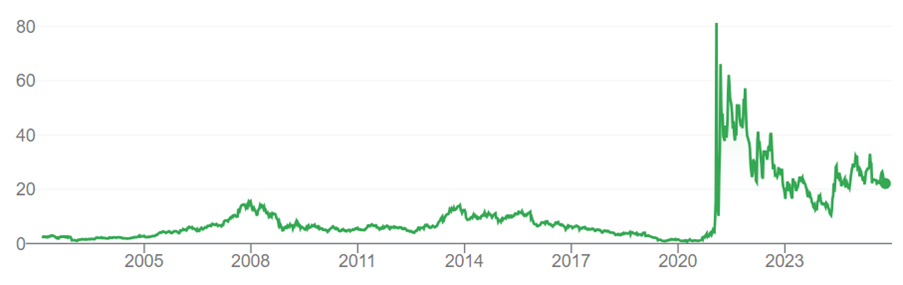
Perhaps the best recent example is GameStop. Back in 2021, the company’s fundamentals screamed ‘over valuation’ and the stock was heavily shorted. In response, a social media amassed herd bet the other way, with millions of small punters buying stock as the shorts tried to close out their positions. Everyone buying at the same time pushed shares to irrational levels and the shorts got torched (see chart below).
Even now, GameStop’s price remains high by traditional metrics. It’s widely seen as a speculative “meme stock”— where returns are driven more by Pavlov’s dog vibes than business performance.
GameStop also marks a shift in how herds form. In times of yore, market info came via newspapers—slow and filtered. Then came the internet: faster, but still mediated by experts. Now, it’s social media and podcasters driving the herd, democratising information at light speed and, in a lot of cases, bypassing any relevant qualifications and meaningful experience.
Social media can scale a herd so large it becomes a market in itself. Fundamentals are for sooks—if enough people believe, the strategy becomes self-fulfilling.
These “meme” herds aren’t your typical investors either. They’re more like diehard footy fans—passionate, tribal, and in it for the camaraderie as much as the capital gains. The power lies in the crowd.
Meanwhile, investment models such as index funds have quietly automated the amplification of herd behaviour. If Investment X doubles in value relative to the index, the fund buys more of it—pushing the price even higher. You can see where this is going.
Looking ahead, AI could amplify herd trends like a Metallica concert rig amplifies a plucked steel string—feedback and all. AI reads patterns, the herd is the pattern, and the circular loop is formed: herd informs AI, AI informs herd, and round we go.
So, what’s this got to do with agriculture? Plenty. While ag markets aren’t yet the playground of meme investors, give it time. There’s room for chaos in every commodity. Farmers traditionally exhibit herd characteristics and even formalise herds through cooperatives. What if a bunch banded together with a gaggle of Redditors to pile into shorted U.S. corn? Could they do it? Theoretically, yes.
More likely, it’ll be foreign players nudging the global herd for strategic gain. With billions at stake, it’s naïve to think rumours won’t be seeded, facts withheld, or trades timed to steer the herd. Every new snippet of info, relevant or not, gets boosted as vloggers and bloggers scramble for content—and the herd reacts accordingly.
It's highly likely we have been seeing this in global grain markets over the past three months, as prices have bounced from one rumour to the next —while fundamental supply and demand hasn’t budged an inch. All analysts can do in response is throw up their hands and mutter, “The market is the market”— commonsense be damned.


